Twitter engagement groups and pods: how they work and what X's rules say
A Twitter engagement group, or pod, is a set of accounts that agree to like, reply to or repost each other's posts soon after they go up, often organised in Telegram or Discord. X's Authenticity policy lists "coordinating to exchange engagement" as engagement spam, so pods break X's written rules. X does not publish how, or how often, it detects them.
A Twitter engagement group, also called an engagement pod, is a set of X (formerly Twitter) accounts that agree to like, reply to or repost each other's posts shortly after they are published, so each post starts with activity it did not earn from its own audience. X's Authenticity policy, checked 18 October 2026, lists "coordinating to exchange engagement in any X features" as engagement spam. The short answer is that pods break X's written rules. What X does not publish is how it detects them, or what any single member should expect to happen.
What a Twitter engagement group is and how pods run
A Twitter engagement group is an agreement between accounts to engage with each other's new posts, usually within a short window after they go up. The aim is to make a post look active early, in the hope that X shows it to more people. "Group", "pod" and "ring" are used interchangeably; the mechanics are the same.
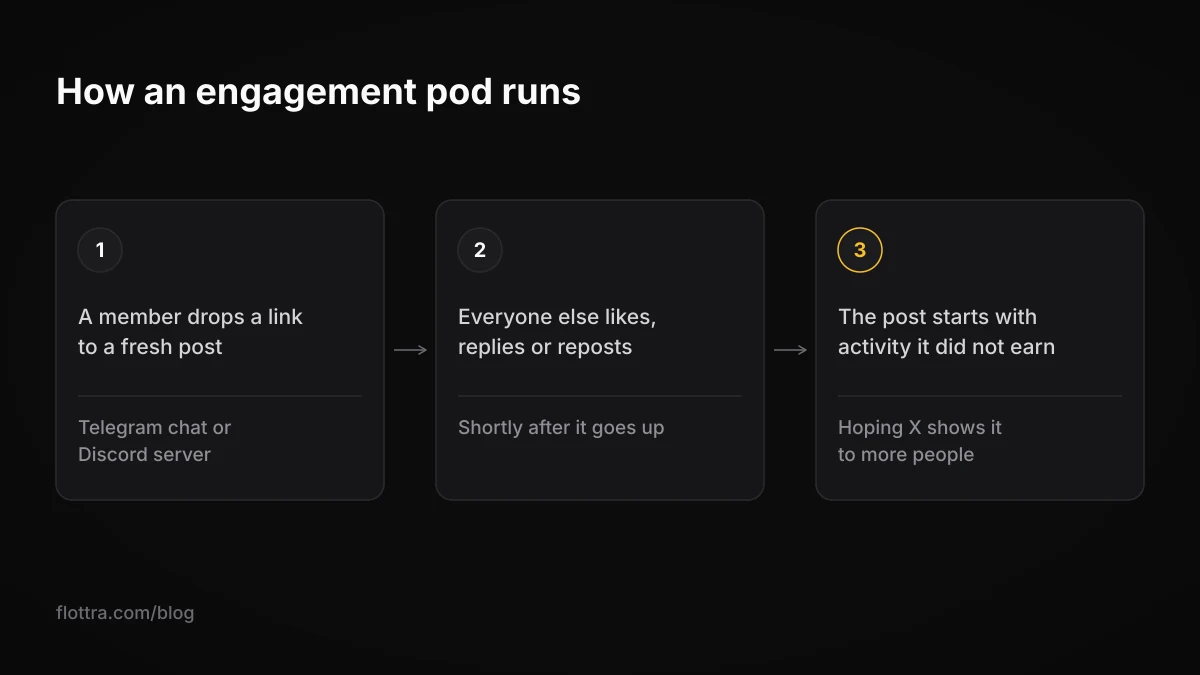
Groups are usually organised outside X, in Telegram chats or Discord servers. A member drops a link to a fresh post and everyone else is expected to like it, reply to it or repost it. They are not hidden: a search of the Discord directory Discadia on 18 October 2026 returned a listing called "Twitter Engagement (X)" that advertised follow-for-follow and like-for-like. There are also open-source Telegram bots built to run pod groups, such as telegram-twitter-engagement-pod-bot on GitHub.
The common formats
- Like-for-like groups: every member likes every other member's posts, whatever they say.
- Reply rings: members leave replies on each other's posts, often short and generic, so the thread looks like a conversation.
- Repost and follow rings: members repost each other or follow each other (follow-for-follow) to raise visible counts.
- Single-operator pods: one person's own accounts all engaging with the same post, by hand or with software. Nobody else is in the group, but X's rules name this case explicitly (see below).
Are engagement groups against X's rules?
Yes. X's Authenticity policy (the page still shows "April 2025" as its date; checked 18 October 2026) prohibits engagement spam: "We prohibit inauthentic use of X engagement features to artificially impact traffic or disrupt people's experience." One of the examples it lists is "coordinating to exchange engagement in any X features, such as Likes, Polls, Replies, Reposts, Lists, Views, or Follows". That line describes an engagement group almost word for word.
An older crawl of the same page, at a language variant of the URL, words the item as "coordinating with and/or compensating others to conduct account metric inflation in any X features, including Likes, Polls, Replies, Reposts, Lists, Views, or Follows". Neither wording requires payment. A free group of peers trading likes is covered as much as a paid service.
The same policy reaches pods from several other angles:
| Pod behaviour | Closest rule line (quoted) | Where it sits |
|---|---|---|
| Members agree to like, reply to or repost each other's posts | "coordinating to exchange engagement in any X features, such as Likes, Polls, Replies, Reposts, Lists, Views, or Follows" | Authenticity policy, Engagement Spam |
| Replies dropped on posts to send attention to a member's account or product | "engaging with posts aggressively or through the use of automation to drive traffic or attention to accounts, websites, products, services, or initiatives" | Authenticity policy, Engagement Spam |
| Many near-identical replies arriving under one post | "Sending bulk, aggressive, high-volume unsolicited replies, mentions, or direct messages" | Authenticity policy, Content Spam |
| One person's accounts all engaging with the same post | "engage with the same posts, accounts, or polls; misuse the mention/reply feature" | Authenticity policy, Inauthentic Accounts |
| A bot liking every link posted in the group | "You may not like posts or hide replies in an automated manner." | Automation rules |
X's top-level Rules summarise all of this as Platform Manipulation and Spam: "You may not use X's services in a manner intended to artificially amplify or suppress information or engage in behavior that manipulates or disrupts people's experience on X." None of these pages states an exemption for Premium or verified accounts.
Pods, niche reciprocity and your own accounts: where the line sits
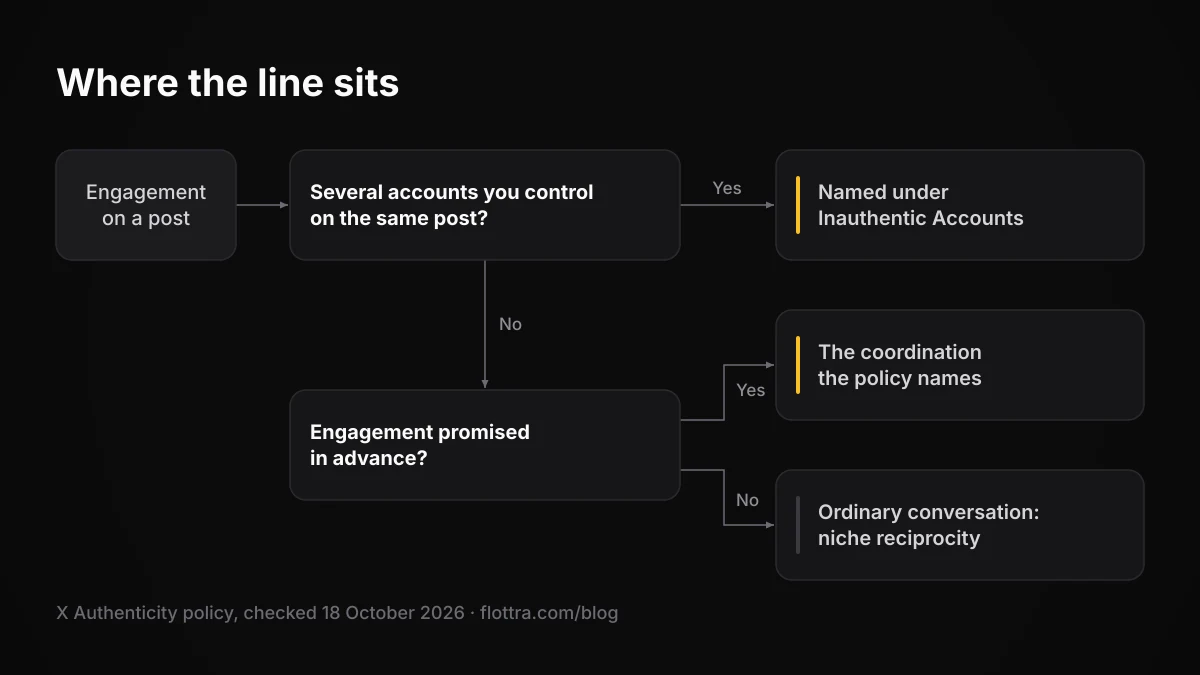
Three different practices get called engagement groups, and they do not sit in the same place against X's text. The test the policy implies is whether engagement is exchanged by agreement, or given because someone read the post and had something to say.
| Practice | What happens | Closest rule line |
|---|---|---|
| Like-for-like or reply group (Telegram, Discord) | Members engage with every link posted, regardless of content | "coordinating to exchange engagement in any X features" |
| Informal niche reciprocity | You read and reply to people in your field; some of them reply to you | No line names ordinary conversation; it turns into coordination once engagement is promised in advance |
| One operator's own accounts on one post | Several accounts you control like or reply to the same post | "engage with the same posts, accounts, or polls; misuse the mention/reply feature" |
Niche reciprocity is how most accounts grow without tricks: you reply to people whose posts you would read anyway, with something specific, and some of them notice you. The drift into a pod is gradual. A group chat where people post links with "please engage" and keep track of who did is the coordination the policy names, even if every reply is typed by hand.
Coordinating around a cause is a separate question. The Authenticity policy has a section on what is allowed, but its exact wording was not verified for this post, so read the current page yourself rather than trusting third-party paraphrases.
Do engagement pods still work on X in 2026?
Nothing X or xAI has published shows that pods raise reach, and the published ranking code gives a reason to expect less than pod sellers claim. xAI publishes the For You feed code at github.com/xai-org/x-algorithm. According to its README, the Phoenix model predicts each viewer's likely actions from that viewer's own engagement history, and the configuration weights multiply that viewer's predicted probabilities. A post is scored for a particular person, on what that person is likely to do with it.
The code does not say how pod engagement is treated. The reasonable reading of per-viewer scoring is narrower than "early likes get you boosted": a stranger in your niche sees your post if the model predicts that stranger will act on it. Pod members who engage with everything say little about that.
Be careful with the multipliers quoted elsewhere. Figures such as replies being "13.5 times" a like come from the 2023 code and are often misread, and a release dated 13 August 2026 added new configuration weights and filtering code. Trending Topics reports that in the August configuration, replies, quotes and DM shares are weighted well above a like, and a predicted report counts heavily against a post. That is a secondary report. If a number matters to you, read home-mixer/params/param.rs in the repository yourself.
Two other claims recur without a source: that the first 30 minutes decide a post's fate, and that X discounts engagement from accounts that always engage with each other. Neither appears in X's documentation or the xai-org README. The second is plausible, but X does not publish its detection rules, so nobody outside X can confirm it.
The practical problem is simpler. Pod members are not your audience. Generic replies from accounts outside your niche read as filler to the people you actually want, and anything that makes a real viewer more likely to mute or report works against the post.
Can an engagement pod get your account limited or suspended?
It can, and X does not publish how likely that is or how long any penalty lasts. X's enforcement options page (checked 18 October 2026) says X suspends an account when it determines a user has "engaged in repeated violations of our policies and/or violated specific policies that cause significant risk to X (i.e. posting illegal content, attempts to manipulate our platform or spam users, using our platform to incite violence, etc.)"
Below suspension, the same page (checked 19 September 2026) lists lighter actions:
- Limited post visibility, which is what people call a shadowban. X never uses that word, but describes "Excluding the post from search results, trends, and recommended notifications", "Downranking the post in replies" and "Restricting the post's discoverability to the author's profile". See X shadowban: how to test for one.
- Read-only mode: "We may temporarily limit an account's ability to post, Repost, or Like."
- Ownership checks: "We may require an account owner to verify ownership with a phone number or email address." A locked account is removed from follower counts, Reposts and Likes until the challenge is done. See getting out of a lock without making it worse.
- Suspension, which the page says users can appeal if they believe X made an error.
No X page gives a duration for any of these, and X does not publish how it finds pods; claims about timing patterns or account graphs are guesses. One public example: Cryptopolitan reported that Nikita Bier, who led X's crackdowns on engagement bait and copied content, posted screenshots of someone offering to boost his engagement, and the account involved was suspended. Bier announced on 5 August 2026 that he was stepping down as head of product and, according to Wikipedia, confirmed on 2 October 2026 that his time at X had ended, so articles describing him as X's current head of product are out of date. For the wider picture, see why X accounts get suspended.
Pods and creator revenue sharing
If the point of a pod is higher payouts, X's Creator Monetization Standards (checked 18 October 2026) tie eligibility to the same rules: "Platform manipulation and spam: you must not engage in the type of behavior that is prohibited by our platform manipulation and spam policy. This includes attempting to artificially inflate engagement or misuse X product features to disrupt others' experience."
X has shown it will act on payouts. On 23 May 2026 Bier said X had found large accounts programmatically reuploading smaller accounts' content to game revenue share and would redirect impressions and monetisation to the original creators; Digital Trends said repeat offenders reportedly saw revenue cut by up to 90 percent. That action was about reuploads, not pods, and X has published no comparable figure for pods.
Using several of your own accounts on the same post
X's Authenticity policy names this case directly. Under Inauthentic Accounts it prohibits "Operating multiple accounts that interact with the same or substantially similar content or in order to inflate or manipulate the prominence of content and/or accounts", with examples that include creating multiple accounts to "engage with the same posts, accounts, or polls; misuse the mention/reply feature; and amplify one of your own accounts by misusing engagement features" (checked 18 October 2026). The text draws no distinction between accounts run by hand and accounts run by software, or between good replies and poor ones.
When software does the work, X's automation rules (the page says "Updated April 2026"; checked 19 September 2026) add further lines:
- Replies: "Automating these actions to reach many users on an unsolicited basis is an abuse of the feature, and is not permitted." The page adds that "sending automated replies to posts based on keyword searches alone is not permitted."
- AI replies: "the deployment or operation of any AI reply bot requires prior written and explicit approval from X."
- Likes: "You may not like posts or hide replies in an automated manner." More in X like bots.
- Browser automation: the ground rules say not to "Use non-API-based forms of automation, such as scripting the X website. The use of these techniques may result in the permanent suspension of your account."
This is where flottra sits, so it is stated plainly. Its auto reply can run reply pods that stagger 3 to 6 accounts on one post. Each account replies from its own real browser, with its own saved profile and proxy, on the customer's own Windows computer, using text the customer or an AI agent supplies, and a reply is marked done only when X confirms it. It does not use the X API, so it works through the X website. It does not claim to comply with the rules quoted above and does not promise that accounts will not be locked, limited or suspended. The rule text is above; the decision is yours.
Separate browsers do not change the rule
Giving each account its own browser profile and proxy is about whether accounts look linked. It does not change what the multiple-accounts line prohibits, which is about what the accounts do, not how they connect.
X publishes no distinction between a pod of real people and a pod of one operator's accounts beyond the policy text. Which replies the automation rules do allow is covered in X reply bots.
Twitter engagement tools: growth tools versus rate checkers
A "Twitter engagement tool" is usually one of two things: a growth tool that helps you write, schedule and reply, or a checker that measures how much engagement your posts get. Neither is an engagement group, but a tool that sends likes or replies on your behalf runs into the same rules as a pod.
- Growth and writing tools. Tweet Hunter's own homepage (checked 18 October 2026) describes it as an X growth tool with AI writing, scheduling, analytics and a CRM for replying to prospects "at scale". Prices are not given here because they were not read from the vendor's page. A side-by-side is at Tweet Hunter compared.
- Engagement rate checkers. These divide engagements by impressions or by followers. Check which one a tool uses before comparing numbers across tools, because the two give very different results for the same post.
- Like and follower sellers. X's automation rules state that "applications that claim to get users more followers are also prohibited under the X Rules." flottra does not sell followers, likes, accounts or proxies.
What X's automation rules allow, action by action
Some tool round-ups say every automated repost is banned. X's automation page says otherwise. The table sets out each action as the page words it.
| Action | Automated use | Rule text (quoted) |
|---|---|---|
| Reposts and quote posts | Allowed for some purposes; bulk or spammy is not | "you may Repost or Quote post in an automated manner for entertainment, informational, or novelty purposes" and "bulk, aggressive, or spammy Reposting is a violation of the X Rules" |
| Likes | Not allowed | "You may not like posts or hide replies in an automated manner." |
| Follows | Not in bulk | "You may not follow or unfollow X accounts in a bulk, aggressive, or indiscriminate manner." |
| Replies and mentions | Only to users who opted in | "you only send one automated reply or mention per user interaction" |
| AI replies | Needs X's approval first | "the deployment or operation of any AI reply bot requires prior written and explicit approval from X" |
What to do instead of joining a pod
The parts of a pod that actually help are the parts X's rules do not object to: reading people in your niche and replying with something specific. Done without an agreement to trade, that is ordinary use of X.
- Reply to posts you would read anyway, with a point the author has not made. Trending Topics' reading of the August 2026 weights puts replies well above likes, and a specific reply gives a real reader less reason to mute or report you.
- If you are in a group with peers, use it to discuss ideas. Do not trade links for engagement or keep score of who engaged.
- Judge results by impressions and by replies from accounts you did not already know, not by raw totals that a group could have produced.
- If you run several accounts, give each its own subject and audience instead of pointing them all at the same posts.
Questions
- Are Twitter engagement groups against X's rules?
- Yes. X's Authenticity policy lists "coordinating to exchange engagement in any X features, such as Likes, Polls, Replies, Reposts, Lists, Views, or Follows" under engagement spam (checked 18 October 2026). No payment is needed for it to apply; agreeing to trade engagement is enough. The X Rules summary separately bans using X "in a manner intended to artificially amplify or suppress information". None of these pages exempts Premium or verified accounts.
- Can an engagement pod get my account shadowbanned?
- It can. X's enforcement options include limiting post visibility, which is what most people mean by a shadowban: excluding posts from search and trends, downranking them in replies, or restricting them to your profile. X does not use the word shadowban, does not publish how it detects pods, and gives no duration for a visibility limit. The same page also lists read-only mode, ownership checks and suspension.
- Do engagement pods affect X creator revenue sharing?
- They can. X's Creator Monetization Standards say you "must not engage in the type of behavior that is prohibited by our platform manipulation and spam policy", including "attempting to artificially inflate engagement". A pod used to lift impressions or replies for payouts is the behaviour described. X has not published what it withholds for pods specifically; the reported cuts of up to 90 percent in 2026 concerned accounts reuploading other people's content.
- Can I use several of my own accounts to reply to the same post?
- X's Authenticity policy names this. It prohibits operating multiple accounts to "engage with the same posts, accounts, or polls", "misuse the mention/reply feature" or "amplify one of your own accounts by misusing engagement features". The text applies however the accounts are run. If software sends the replies, the automation rules on unsolicited automated replies, and the requirement for X's prior written approval of AI reply bots, apply as well.
- What is the difference between a pod and replying to people in my niche?
- Agreement. In a pod, engagement is promised in advance and exchanged regardless of what the post says. In niche reciprocity you reply because you read the post and had something to add, and others may do the same with no deal behind it. The first matches the policy's "coordinating to exchange engagement" line; the second is ordinary use of X. A chat that shares links and tracks who engaged has crossed into the first.
- Are automated reposts allowed on X?
- Some are. X's automation rules (checked 19 September 2026) say you may Repost or Quote post "in an automated manner for entertainment, informational, or novelty purposes", while bulk, aggressive or spammy reposting breaks the X Rules. Automated likes are not allowed at all, and automated follows may not be bulk, aggressive or indiscriminate. Articles saying every automated repost is banned have misread the page.
- Do pods still work with X's open-source algorithm?
- There is no published evidence that they do. The August 2026 xai-org release scores each post for each viewer, using that viewer's predicted actions from their own engagement history. Engagement from pod members outside your audience says little about what a stranger in your niche will do. No X document supports a "first 30 minutes" rule, and multipliers quoted from the 2023 code are out of date.