AI tweet generators: getting posts that do not read like AI
Any AI tweet generator or chatbot (ChatGPT, Claude, Grok) will draft a tweet. It stops reading like AI when you supply the account's voice, real example posts and a specific point, then edit out known tells such as em dashes and puffery. No X Help Center page checked for this article bans AI-written text, but X's rules on AI reply bots, fake personas and duplicate content apply.
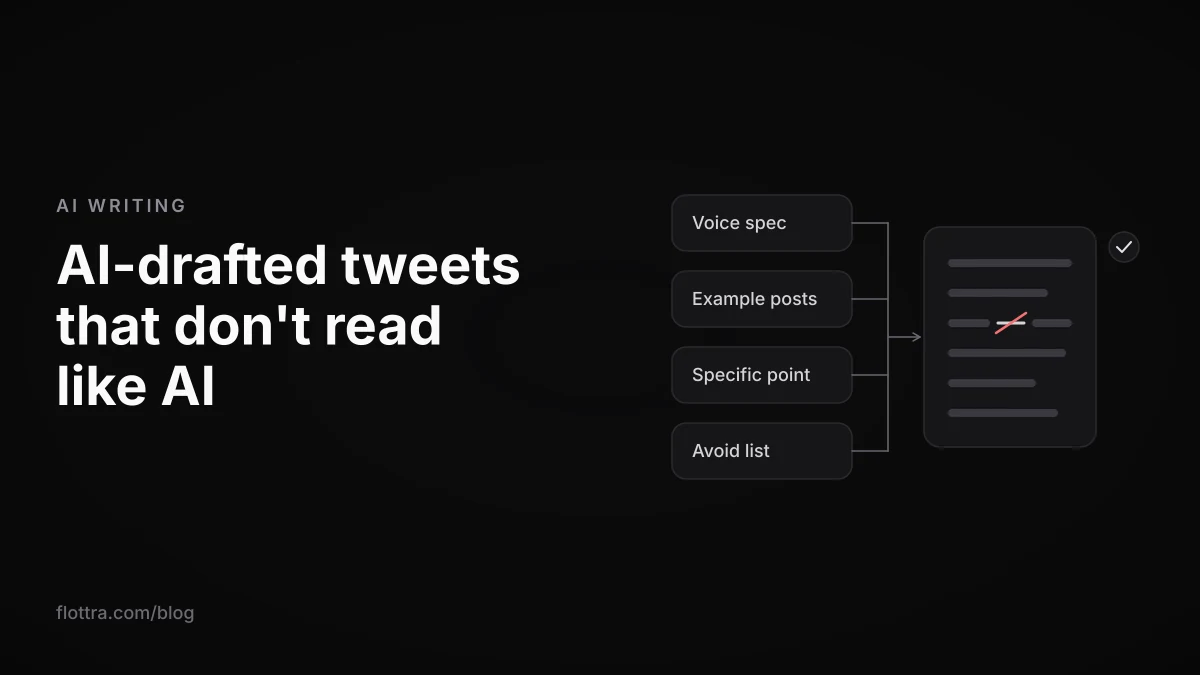
Any AI tweet generator, or a general chatbot such as ChatGPT, Claude or Grok, will write a tweet in seconds. That is the easy part. The output stops reading like AI when you give the model the account's voice, real example posts and a specific point to make, then edit out the known tells by hand. No X (formerly Twitter) Help Center page found for this article bans AI-written text or asks you to label it, but X's rules on automation, AI reply bots, fake personas and duplicate content across accounts apply to whatever you publish, whoever or whatever drafted it.
Free AI tweet generators, and what their own pages say
Most of the AI tweet generators that rank in search are free forms on vendor sites: you type a topic, pick a tone and get a few drafts. Each will give you a draft to start from, and none of them knows your account. The table states only what each vendor's own page says, checked 18 October 2026. Usage caps on the free versions were not checked.
| Tool | What the vendor's own page says |
|---|---|
| Typefully AI tweet generator | Describes it as a free tool, and says the tool complements human writing rather than replacing it. |
| Hootsuite AI tweet generator | Free, writes in English, Spanish, Italian, French and German. The page still refers to Twitter captions; a search engine dates it at around three years old. |
| Pallyy tweet generator | Runs on the page with no sign-up. Advises copying the best draft and making it your own. |
| Trickle AI tweet generator | Free with no sign-up. You pick tone, language and creativity level. |
| XLab AI tweet generator | Connects to your X account, analyses your past tweets to learn your style, lets you choose Claude or GPT-4. Free trial of 30 AI credits. |
| Circleboom AI tweet generator | Built on an OpenAI/ChatGPT integration, with tone, emoji and hashtag options. |
Two of these pages say the useful part themselves: Typefully's calls its tool a complement to human writing, and Pallyy's tells you to make the draft your own. That is the method in the rest of this post. A chatbot you already use does the same job with more control, because you can paste in examples and rules a form never asks for, which is what most people searching "chatgpt twitter" are doing already.
How to use ChatGPT, Claude or Grok to write tweets
To get usable tweets from ChatGPT, Claude or Grok, give the model four things a generator form does not: a written voice spec for the account, real posts from that account as examples, the specific point or source the post is about, and a short list of patterns to avoid. Ask for several drafts, choose one and edit it by hand. Claims that one model sounds more human than another were found only on vendor blogs, with no published evidence behind them, so pick the one you find easiest to steer.
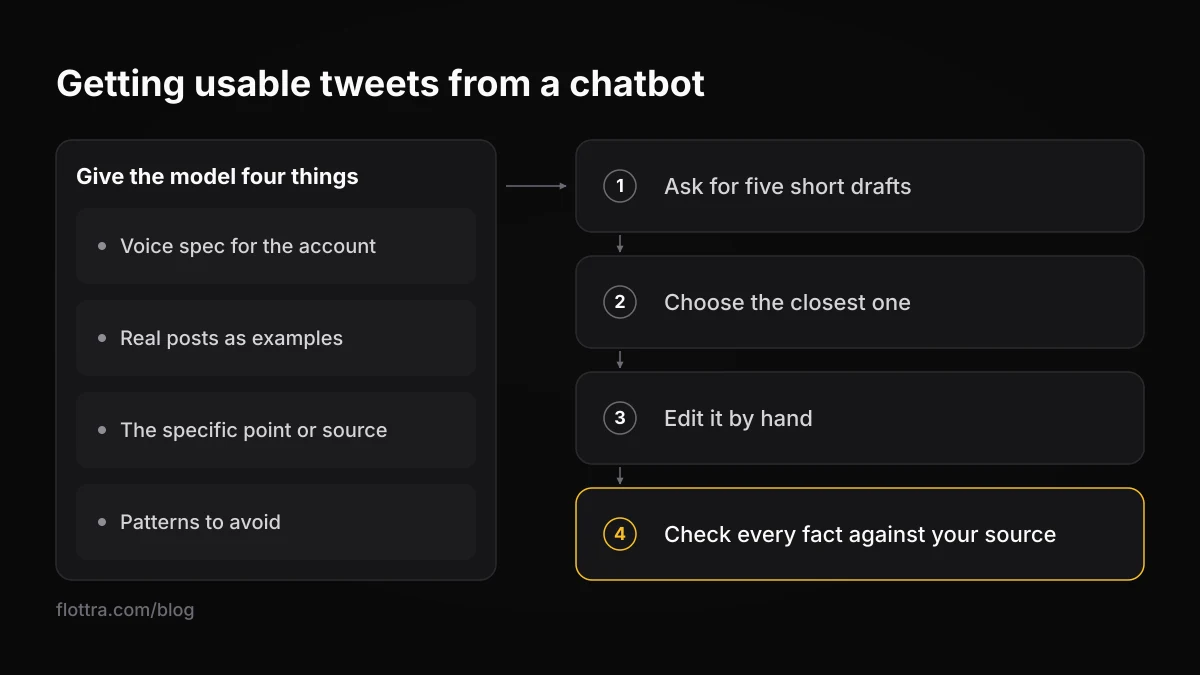
- Paste the account's voice spec (next section) at the top of the conversation, or into the chatbot's custom instructions or project settings if you write for this account often.
- Paste a handful of real posts from the account, the ones that sound most like it. Say they are examples of voice, not topics to copy.
- Give the substance: the fact, link, figure, opinion or thing the account saw. A model with no material writes filler. A model with one specific detail writes a post.
- Ask for five short drafts at the length the account actually uses, in plain text, with no hashtags or emoji unless the spec says the account uses them.
- Tell it not to add facts you did not supply. Then check anyway.
- Choose the closest draft and run the editing pass further down. Read the result next to the account's last few real posts; if it would stand out, rewrite it.
A prompt you can adapt
Illustrative prompt, not a tested recipe: You are writing posts for one X account. Voice: [paste spec]. Examples of how this account writes: [paste posts]. Write 5 drafts about: [the specific point, with its source]. Under 200 characters. Plain text. No hashtags, no emoji, no em dashes, no "it's not X, it's Y" lines, no closing summary sentence. Use only the facts given here.
How to keep a different voice on each account
To keep a distinct voice on each X account, write a short voice spec for every account before you generate anything, save it, and paste it in every time you draft for that account. Without one, every account drifts towards the chatbot's default register, which is the register readers have learned to recognise. Real posts from the account do more than adjectives: "witty and concise" tells the model little, ten sentences the account actually wrote tell it a lot.
| Field | What to write | Example (illustrative) |
|---|---|---|
| Topics | The few subjects this account posts about, and the ones it never touches. | Commercial cycling, bike shop margins. Never politics. |
| Opinions | Positions the account holds, so drafts take a side instead of summarising both. | Thinks carbon frames are oversold to commuters. |
| Vocabulary | Words and phrases it uses, and the level of jargon. | Says "shop" not "store", uses trade terms without explaining them. |
| Sentence length and form | Short or long, capitals or lower case, questions or statements. | Short declaratives, lower case, rarely asks questions. |
| Emoji and hashtags | Whether it uses them at all, and which. | No emoji. One hashtag a week at most. |
| Avoid list | A short list of words and patterns this account never uses. | No "pivotal", no exclamation marks, no threads. |
Keep the avoid list short enough that you can check every item by eye, because the edit is where it gets enforced; the research on em dashes below shows that instructions alone do not hold. Store each spec somewhere you will actually reuse it: a document per account, a saved chatbot project, or the tool you run the accounts in. In flottra, each account can carry one AI persona (topics, voice, avoid list, length and emoji habits) drafted from a brief with your own Anthropic key and then edited by you; it does not post in that voice by itself yet.
If you run more than a few accounts, the specs are also the check that they are genuinely different people with different interests, not one voice with the nouns changed. The section on X's authenticity policy below explains why that matters beyond style. For the wider setup, see how many X accounts you can have, and how to run them.
The signs that make a tweet read like AI
The giveaway signs of AI writing are documented. Wikipedia's editors keep a public list, Signs of AI writing (checked 18 October 2026), built from real chatbot text: inflated significance, shallow "-ing" clauses that claim meaning, vague attributions, Markdown formatting, summaries tacked on at the end, and a set of words to watch. The page says these signs do not prove AI authorship on their own, and write-ups of the guide stress that they count when they pile up. One is a style choice. Several in one short post read as a chatbot.
| Tell | What it looks like (illustrative) | Fix |
|---|---|---|
| Puffed-up significance | "This marks a pivotal moment for the industry." | Say what happened and to whom. |
| Superficial "-ing" clause | "Shipped v2 today, highlighting our commitment to speed." | Cut everything after the comma. |
| Negative parallelism | "It's not a tool, it's a mindset." | State the one claim you mean. |
| Vague attribution | "Experts agree that..." | Name the source, or drop the claim. |
| Words to watch | underscoring, highlighting, fostering, enhancing, valuable insights, resonate with, align with | Use the plain verb, or delete the phrase. |
| Markdown | Asterisks for bold, bullet lists, headings pasted into the composer | Plain text only. |
| Summarising closer | "In short, consistency wins." | End on the last real point. |
| Em dash overuse | Two clauses joined by a long dash, several times a week | Comma, colon, full stop or parentheses. |
Why "no em dashes" in the prompt is not enough
A 2026 arXiv paper (checked 18 October 2026) tested twelve models from five providers. Written instructions removed, or nearly removed, Markdown formatting, but em dashes persisted. Put the rule in your prompt anyway, then search every draft for the em dash character (U+2014) and the en dash (U+2013) before you post. Rewrite the sentence around each one rather than swapping in a spaced hyphen, which leaves the same shape. Whether ChatGPT's custom instructions now hold on this was not checked for this article.
An editing pass, in order
- Delete the first sentence if it only sets up the second.
- Delete the last sentence if it summarises or moralises.
- Search for long dashes and rewrite each sentence that has one.
- Remove every word from the watch list and from the account's own avoid list.
- Replace one general claim with something specific: a sourced number, a name, a date, a thing the account saw.
- Check every fact against your source. The model may have added detail you never gave it.
- Strip hashtags and emoji the account would not use, then read the post next to its last few real ones.
Does X allow AI-generated posts, and do you have to label them?
No X Help Center page found for this article bans AI-written text posts or requires a label on them. The policy people sometimes cite, the synthetic and manipulated media policy (dated April 2023, checked 18 October 2026), is about media such as images, video, audio, gifs and links: “You may not share synthetic, manipulated, or out-of-context media that may deceive or confuse people and lead to harm”. It is not a rule about AI-written text.
What does apply is responsibility. X's automation rules (page says "Updated April 2026", checked 19 September 2026) state: “For X users: You are ultimately responsible for the actions taken with your account, or by applications associated with your account.” If a model invents a fact and you post it, the post is yours.
Can X detect AI-written tweets?
Nobody outside X can say for certain, because X does not publish its detection rules, and no official statement was found that it detects, downranks or shadowbans AI-written text. What X does document, on its enforcement options page (checked 19 September 2026), is how it limits posts that violate its policies: excluding them from search results and trends, removing them from the For you and Following timelines, downranking them in replies. On that wording, the measures attach to policy violations such as spam; the page says nothing about who or what drafted the words. The shadowban guide covers how to check whether your posts are being limited.
Posting a batch: the daily limits
If you generate a week of posts in one sitting, the posting side has limits. X's limits page (checked 19 September 2026) says: “Posts: 50 original posts and 200 replies per day for unverified accounts. The daily update limit is further broken down into smaller limits for semi-hourly intervals.” Lower down, the same page still says “The post limit of 2,400 updates per day is further broken down into semi-hourly intervals.” The page contradicts itself; the 50 and 200 figures are the ones in its current-limits list. Premium accounts may differ, but the page does not state a number. More in X rate limits.
Running AI personas on several accounts: what X's rules say
For anyone running several X accounts, the rules that matter are not about AI text but about how the accounts behave together. X's authenticity policy (page says "April 2025", checked 19 September 2026) has three clauses that bear directly on AI personas and on reusing drafts across accounts:
- “Multiple Accounts and Coordination: We prohibit coordinated inauthentic activity that artificially influences conversations or disrupts X.”
- “Content Spam: You may not share or post content in a bulk, duplicative, irrelevant or unsolicited manner that disrupts people's experience.”
- “Fake personas: You may not use manufactured identities to engage in disruptive or deceptive behavior. This may include using stock, stolen or AI-generated profile photos, copied or stolen profile bios, and/or misleading profile information for the purpose of deceiving others.”
Read the Fake personas clause to the end. It names AI-generated profile photos and copied bios as examples, and ties them to a purpose: "for the purpose of deceiving others". On its wording it is not a blanket ban on AI photos or on giving an account a defined voice. Whether a given set of accounts is deceptive or coordinated is a judgement X makes about what the accounts do, and you should read the clauses and decide where your own use sits.
The practical line is simpler. Never paste one draft into several accounts, even reworded, and never have several accounts push the same point at the same time. Each account needs its own topics, opinions and source material, which is what a separate voice spec forces. A reskin of one persona with different names is still one persona.
One draft, many accounts
Generating one post and spinning variants of it for ten accounts is the pattern the Content Spam and Coordination clauses describe: duplicative content and accounts acting together to influence a conversation. Rewording the text does not change what the accounts are doing together.
No tool or writing method guarantees an account will not be suspended. See why X accounts get suspended for the signals that tend to get accounts caught.
Can you use AI to reply to tweets automatically?
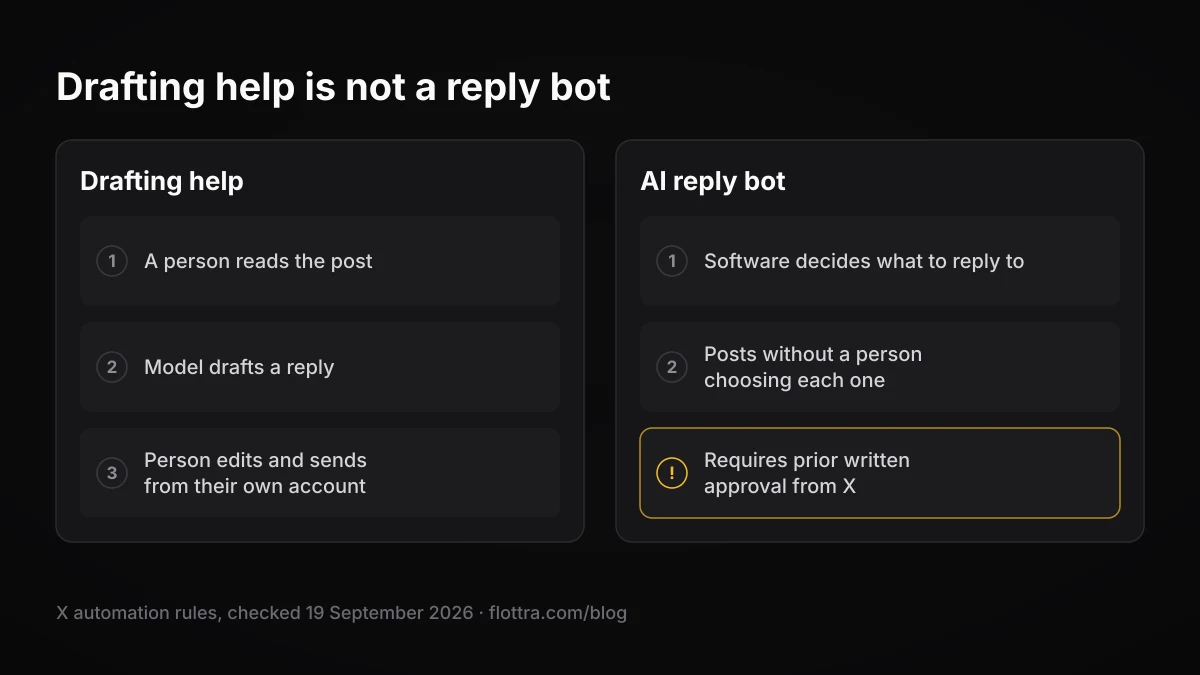
Not without X's prior written approval, and approval does not lift the other reply rules. X's automation rules say that "the deployment or operation of any AI reply bot requires prior written and explicit approval from X." The version of the page seen in search results on 18 October 2026 adds the route: “Contact your dedicated point of contact or submit a request through the developer portal for review.” The same rules (checked 19 September 2026) name keyword-triggered replies as not permitted: “Automating these actions to reach many users on an unsolicited basis is an abuse of the feature, and is not permitted. For example, sending automated replies to posts based on keyword searches alone is not permitted.”
The February 2026 API change
Since 23 February 2026, X API v2 accepts a reply only when the original author has summoned the replying account, by mentioning it or quoting one of its posts. X's developer forum announcement (checked 18 October 2026) puts it as: “replies via the API will only be permitted if the replier has been explicitly summoned by the original post’s author.” X also restricted programmatic mentions and quotes, and gave the reason: “Programmatic replies have been heavily used by developers (including AI-assisted ones) to insert low-quality or automated content into conversations, creating a significant spam problem that threatens the quality of discussions on X.”
Drafting help is not a reply bot
There are two different things here. In the first, a person reads a post, asks a model for a reply draft, edits it and sends it from their own account. In the second, software decides what to reply to and posts without a person choosing each one. The approval requirement is written about the second. Public approval requests on X's developer forum (checked 18 October 2026) show what applicants commit to: replies only when a user starts the interaction, one reply per interaction, the Automated account label, disclosure in the bio, a named human operator and honouring opt-outs. Those are the applicants' own commitments, not a checklist X has published, and no approval criteria or response time were found.
Sending through the website with a script instead of the API is covered separately. The automation rules list as a Don't: “Use non-API-based forms of automation, such as scripting the X website. The use of these techniques may result in the permanent suspension of your account.” The authenticity policy also lists “Unauthorized automation: Automated or scripted accounts that do not comply with our Developer Policy.” The X reply bots guide covers which replies the rules allow and where AI replies tend to go wrong.
Questions
- Is there a free AI tweet generator that needs no sign-up?
- Yes. Pallyy's tweet generator runs on the page with no sign-up, and Trickle's page says its generator is free with no sign-up and lets you pick tone, language and creativity level. Hootsuite and Typefully also describe their generators as free. All four were checked on the vendors' own pages on 18 October 2026; free-tier usage caps were not. A free chatbot you already use does the same job and lets you paste in example posts, which matters more than which form you type into.
- Does X allow AI-generated posts, and do I have to label them?
- No X Help Center page found for this article bans AI-written text posts or asks you to label them. The synthetic and manipulated media policy covers deceptive images, video, audio, gifs and links, not text. The rules that do apply are about behaviour: you are responsible for what your account posts, an AI reply bot needs X's prior written approval, and duplicative content or coordinated activity across accounts is prohibited by the authenticity policy.
- Can X detect AI-written tweets and limit their reach?
- Nobody outside X can say for certain, because X does not publish its detection rules and no official statement was found that it detects or downranks AI-written text. What X does document is limiting the visibility of posts that break its rules, for example removing them from search or the For you timeline. On the published policy, that treatment follows a violation such as spam or coordination, not the fact that a model drafted the words. The accuracy of AI-text detectors on short posts was not assessed here.
- How do I stop ChatGPT using em dashes?
- Ask, but do not rely on the instruction. A 2026 arXiv paper testing twelve models from five providers found that written instructions removed Markdown formatting while em dashes persisted. Put the rule in your prompt or custom instructions, then search every draft for the character `U+2014` (and the en dash, `U+2013`) before you post. Rewrite the sentence around each one using a comma, colon, full stop or parentheses; a spaced hyphen in the same spot keeps the same shape.
- Can Grok write or post tweets for me?
- Grok, like ChatGPT or Claude, will draft a post if you ask it, and you then paste, edit and send it yourself. Reports of an AI enhance button in X's web composer, and of a Grok connector that can only read, come from third-party blogs rather than X or xAI pages, so treat them as unconfirmed. Whichever model drafts the text, X's automation rules leave responsibility with you, and any AI reply bot needs X's prior written approval.
- Is running AI personas on several accounts against X's rules?
- The authenticity policy clauses quoted in this article do not mention AI-written text, but they prohibit "coordinated inauthentic activity that artificially influences conversations or disrupts X", duplicative content, and fake personas used "for the purpose of deceiving others", naming AI-generated profile photos and copied bios as examples. A distinct voice per account is a writing practice; whether a set of accounts is coordinated or deceptive is a judgement X makes about what they do together. Read the clauses and decide where your use sits.
- What is a good prompt for writing tweets?
- One that carries material rather than adjectives: the account's voice spec, several of its real posts as examples, the specific fact or opinion the post is about with its source, a target length, and a short avoid list (hashtags, emoji, em dashes, "it's not X, it's Y", closing summaries). Ask for several drafts and tell the model to use only the facts you supplied. Then edit by hand; the prompt gets you a draft, not a finished post.