Lead generation on X in 2026: what works without spam
Lead generation on X has a paid and an organic route. Paid: Lead Gen Ads, the native lead form X relaunched in August 2026 (the old lead generation cards were retired in 2017), or ads sent to a form on your own site. Organic: a clear profile, useful posts and hand-written replies to people asking for help. X's rules ban unsolicited automated DMs and keyword-triggered auto replies.
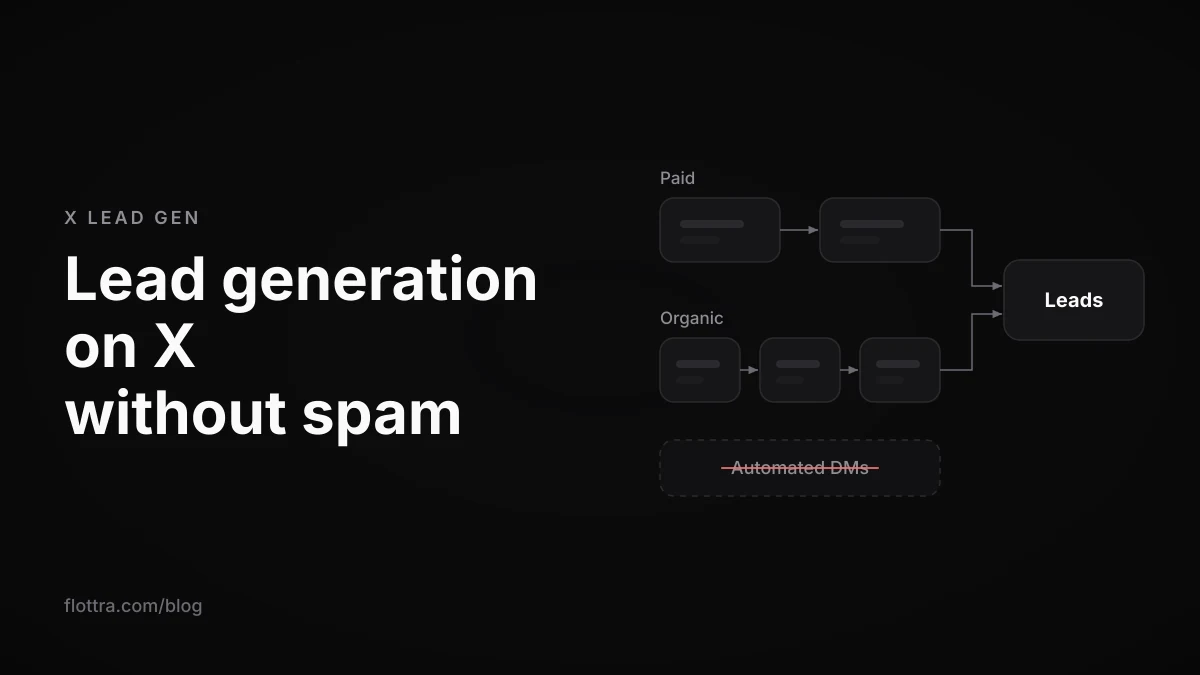
Lead generation on X (formerly Twitter) runs on two tracks in 2026. The paid track: X relaunched native lead forms as Lead Gen Ads in late August 2026, after Twitter retired its lead generation cards in 2017, and you can still send ad traffic to a form on your own site instead. The organic track: a profile that tells a visitor what to do next, posts that show you understand a buyer's problem, and replies you write yourself to people who are asking for help. The usual shortcuts (unsolicited automated DMs, keyword-triggered replies, unapproved AI reply bots, several accounts boosting one post) are each named in X's rules, and this post quotes the exact line for each.
Do Twitter lead generation cards still exist?
Not in their original form, but native lead forms are back. Twitter stopped new lead generation campaigns on 1 February 2017 and stopped showing the cards on 1 March 2017. On 25 August 2026 X announced Lead Gen Ads, which put a lead form inside the app again, and its Ads API attaches that form to a card. Most pages ranking for the term still describe the cards as gone for good.
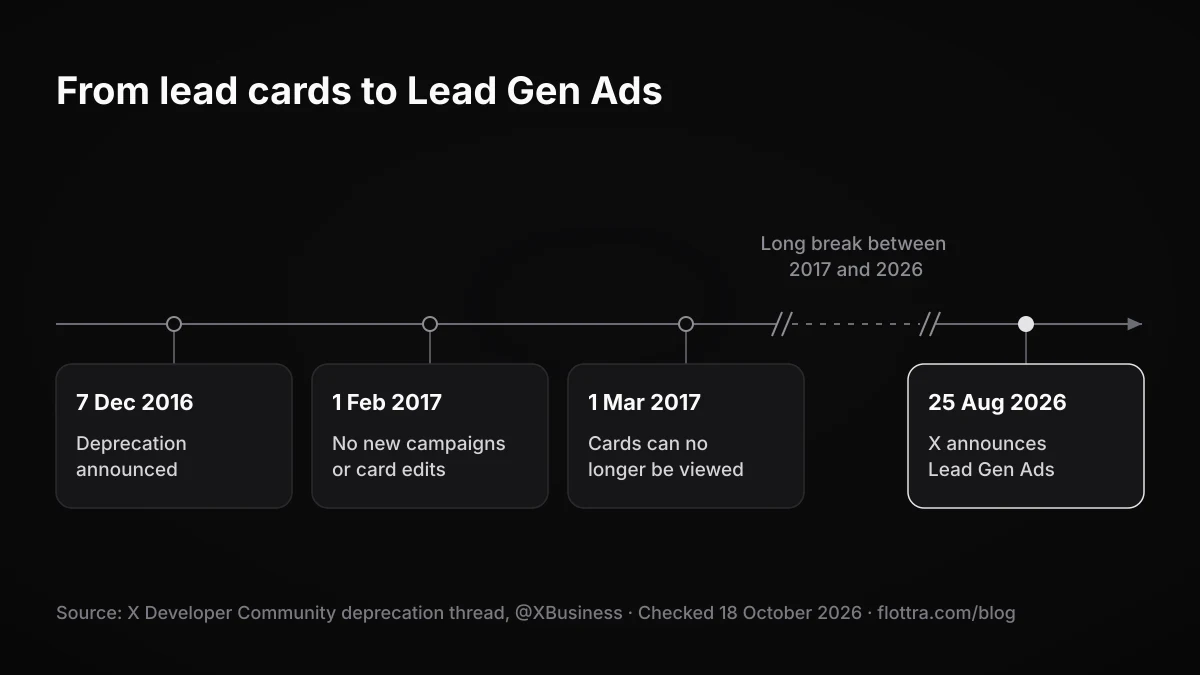
The retirement is documented in Twitter's own deprecation announcement of 7 December 2016 (checked 18 October 2026). It ran in two phases: from 1 February 2017, no new LEAD_GENERATION campaigns and no creating or editing cards; then "On 2017-03-01, it will no longer be possible to view lead generation cards". Campaign analytics stayed available. In April 2017 the same thread shows the API rejecting the old objective: "The line item objective LEAD_GENERATION is no longer supported."
The old card pre-filled the user's name, @username and email address when they clicked the button, which made it popular for growing email lists, as Social Media Today reported. On the reason, Twitter told Marketing Dive it would focus on its other performance ad products. Other explanations you will read are guesses.
| Date | What happened |
|---|---|
| 7 December 2016 | Twitter's Ads API team announces lead generation will be deprecated in two phases |
| 1 February 2017 | No new LEAD_GENERATION campaigns; cards can no longer be created or edited |
| 1 March 2017 | Lead generation cards can no longer be viewed; campaign analytics stay available |
| 5 April 2017 | The API returns "The line item objective LEAD_GENERATION is no longer supported." |
| 25 August 2026 | @XBusiness announces Lead Gen Ads and points advertisers to their X sales rep |
| 26 August 2026 | Social Media Today reports the format as a revival of Twitter's retired lead gen ads |
How X Lead Gen Ads work in 2026
Lead Gen Ads are promoted posts with a native form: the person taps the call to action, fills in a form inside X and never leaves the app. X's launch article (checked 18 October 2026) lists these parts:
- One-tap lead capture in a native X form, pre-filled after the first submission.
- Image, video, carousel and Timeline Takeover formats.
- A new Leads objective in Ads Manager.
- "Leads delivered in a new Leads Center in Ads Manager, ready for clients to export or send to their CRM".
- Built-in consent and privacy controls.
X names the uses it has in mind: "booking demos and appointments, growing email lists and waitlists, capturing quote requests, sweepstake entries, and filling webinars, events and classes". It also says "The result is more leads, higher lead quality, and lower cost per lead." That is a marketing claim. X published no cost per lead or conversion figures behind it, so this post gives none.
Social Media Today described the ads on 26 August 2026 as having a coloured call-to-action bar on the promoted post, its colour taken from the dominant colour of the image or video. Marketing-Interactive reports it is X's first new ad product since the ad platform rebuild X announced in April 2026.
What the Ads API documentation says
X's Ads API documentation (checked 18 October 2026) now has a Lead Generation section: "Lead Gen Ads collect contact information in a native form on X." A lead form (introduction, fields, privacy policy and an optional thank-you page) is attached to a card through a LEAD_FORM destination, and the card is promoted like any other creative. Submissions export as JSON, CSV or XLSX. The Leads API needs the Campaign user permission on the ads account, and "Lead exports are further restricted to account administrators, because exported files contain personal information." In practice, the lead generation card is back under a new name.
Availability is not settled
The launch tweet says "Reach out to your X Sales Rep for exclusive access today." The launch article says the ads are available to advertisers globally, with an asterisk whose footnote this research did not capture. X's public campaign types page, as last indexed, listed Reach, Video views, App installs, Engagement and Website conversions, with no Leads objective. The practical test is your own Ads Manager: if the Leads objective is there, you have it; if not, ask your X sales contact.
Also unconfirmed: the full list of form fields, whether email is pre-filled from the X account as on the 2016 card, and which CRMs connect by name. X's sources say only export or send to a CRM.
Native lead form or your own landing page?
Use the native form when leaving X is what loses you the lead; use a landing page when you need your own qualifying questions, your own consent wording or a page you control. The landing-page route is a website conversions campaign. X's help page (checked 18 October 2026) says: Choose "Sales" from the list of campaign objectives. The Web conversions goal is then pre-selected. That page and the campaign types page name the objective differently, so the labels in your Ads Manager may match neither.
| Native lead form (Lead Gen Ads) | Landing page (Sales objective, Web conversions) | |
|---|---|---|
| Where the form lives | Inside X, attached to the promoted post | On your own site |
| How leads reach you | Leads Center in Ads Manager, export or CRM; API export as JSON, CSV or XLSX | Your own form tool or CRM |
| Who handles the contact data | X holds it; API exports limited to account administrators | Your site holds it; X sees the conversions you track |
| Friction for the person | No page load; form pre-filled after the first submission | A page load and a form to fill in |
| Availability | May depend on your ads account | Described on X's business help pages |
| What to check | Lead quality, since a pre-filled form is quick to submit | Drop-off between the click and the form |
Whichever you pick, judge X on qualified leads (people who booked, replied or bought), not on submissions. X has published no cost per lead for the new format, and the percentages on several pages ranking for this topic (share of B2B marketers on X, impressions lift from pinned posts, a fixed reply window) carry no source. Your own CRM is the number to trust.
Setting up your X profile and posts for inbound leads
Organic leads on X arrive through your profile: someone sees a post or a reply, clicks your name and decides quickly whether you can help them. Treat the profile as the landing page and the posts as the reason anyone visits it.
- Bio: who you help, with what, and what to do next. A job title alone gives a stranger nothing to act on.
- Link: one destination with one action (book a call, join a waitlist, get a resource), not a page of links.
- Pinned post: the post you want a new visitor to read first, usually a concrete example of the problem you solve, the offer and the link.
- Name and photo: a real person or a real brand. X's authenticity policy counts stock, stolen or AI-generated profile photos used to deceive as fake personas.
Posts that bring leads show the work: a problem your buyer has, how you would handle it, what it cost someone who left it. Keep each account's posts its own. X's authenticity policy (checked 19 September 2026) says "You may not share or post content in a bulk, duplicative, irrelevant or unsolicited manner that disrupts people's experience."
You will read that X cuts the reach of posts containing links. It is widely repeated, but this post found no official X source confirming it, so treat it as unconfirmed and compare a link in the post with a link in a reply on your own account.
Inbound only works if your posts can be found. X's enforcement options (checked 19 September 2026) include "Excluding the post from search results, trends, and recommended notifications", the official version of what people call a shadowban. A limited account can keep posting and receive no inbound at all; the shadowban guide covers how to test for it.
Finding prospects with X search and replying by hand
The most direct organic route on X is to find people already asking for what you sell and answer them well, in public, by hand. X's search and its Advanced Search form let you search exact phrases and exclude words, which is enough to surface buying-signal posts.
- List the phrases a buyer uses when they need you: asking for recommendations, "alternative to" plus a competitor's name, complaints about a specific problem.
- Search each as an exact phrase, exclude words that bring noise (jobs, giveaways, your own name) and sort by latest.
- Open the profile before replying. If it is a competitor, a bot or someone with no use for what you sell, move on.
- Reply with the answer, not a pitch: the fix, the tool, the figure they need. Mention what you do only if it is the answer.
- Add people worth watching to a private List, so you see their next posts without following hundreds of accounts.
- Move to DMs only when they ask, or reply asking for more.
This is slow on purpose. X's automation rules (checked 19 September 2026) name the fast version: "sending automated replies to posts based on keyword searches alone is not permitted." Automated replies are allowed only when the person opted in, one per interaction, with an opt-out, and "a user following your account is not on its own a sufficient indication of user intent to receive an automated response."
AI-drafted replies and reply bots
X's rule is written about bots: "the deployment or operation of any AI reply bot requires prior written and explicit approval from X." Using AI to find posts and draft a reply that you read, edit and post yourself keeps a person deciding each reply, but the responsibility does not move: "You are ultimately responsible for the actions taken with your account, or by applications associated with your account." One page ranking for this topic says replies sent through the X API have been blocked since 23 February 2026 unless the author mentioned or quoted you; this post could not find that on an X page, so it is not stated as fact. The reply bots guide covers which replies the rules allow.
Volume is not the constraint. The X limits page (checked 19 September 2026) allows "50 original posts and 200 replies per day for unverified accounts". Lower down, the same page still mentions 2,400 updates a day, so it contradicts itself; the 50 and 200 figures are in the current list. Nobody writes 200 useful replies a day by hand, and replies that read as copies are what the content spam rule describes.
DMs to prospects: what X's rules allow
X allows DMs to prospects who asked for them and prohibits unsolicited DMs sent in bulk or by automation. The automation rules (checked 19 September 2026) say "You may not send unsolicited Direct Messages in a bulk or automated manner", and being able to message someone, because they follow you or have open DMs, "does not necessarily mean they have requested or expect to receive automated Direct Messages from you."
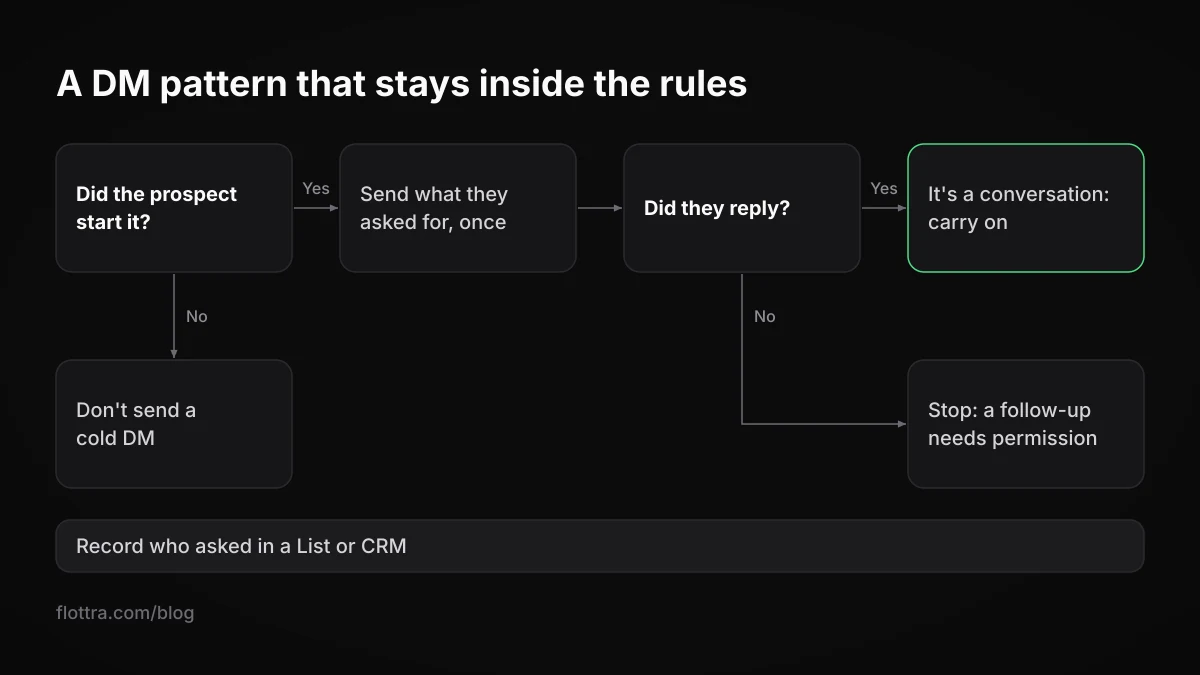
Follow-up sequences, the core of most outreach tools, meet this line: "After a user-initiated interaction ends, don't send additional follow-up Direct Messages or mention users in a post unless you get permission from the user."
The 500 figure is a ceiling, not an allowance. The limits page says "Direct Messages (daily): The limit is 500 messages sent per day." That is what the system lets through, not what the rules allow for cold outreach, and people can restrict who may message them, so the 500 says nothing about how many prospects you can actually reach. X publishes no hourly DM limit. The DM limits guide covers this in detail.
A DM pattern that stays inside the rules
- The prospect starts it: they DM you, reply asking for details, or answer a post where you offered to send something.
- You send what they asked for, once.
- If they reply, it is a conversation; carry on.
- If they go quiet, stop. A follow-up needs their permission under the rule above.
- Record who asked (a List or your CRM), so nobody gets a second cold message from another account.
Read-only mode cuts your DMs too
X's enforcement options include read-only mode: "We may temporarily limit an account's ability to post, Repost, or Like. The user can read their timelines and will only be able to send Direct Messages to their followers." An account placed in read-only mode can no longer message any prospect who does not already follow it. X publishes no duration for these restrictions.
Using several accounts to reach prospects
X's help pages explain how to add and switch between several accounts, so having more than one is not the issue; most ways of using extra accounts for lead generation are. The authenticity policy (checked 19 September 2026) says "We prohibit coordinated inauthentic activity that artificially influences conversations or disrupts X." and "We prohibit inauthentic use of X engagement features to artificially impact traffic or disrupt people's experience."
- Several accounts liking or replying to a prospect's post, or to your own post to lift it: coordination and engagement spam, plus "You may not like posts or hide replies in an automated manner." if a tool does the liking.
- Persona accounts for outreach with invented names and generated faces: the fake personas clause covers "using stock, stolen or AI-generated profile photos, copied or stolen profile bios, and/or misleading profile information for the purpose of deceiving others."
- Following a competitor's followers: the follow limits page prohibits "duplicating another account's followers, particularly using automation", and the limits page calls 400 follows a day "a technical account limit only, and there are additional rules prohibiting aggressive following behavior."
If you run several accounts for straightforward reasons (separate brands, regions or team members), the operating setup still matters. Flottra, for example, runs each account in a real browser on your own Windows computer with its own saved profile and proxy, and applies hourly ceilings per account by default (replies 5, DMs 3, follows 6), which are ceilings, not targets. Its pods stagger 3 to 6 accounts replying to one post; read the coordination and keyword-reply rules quoted above before pointing that at a prospect's post. It does not use the X API, and X's automation rules list "non-API-based forms of automation, such as scripting the X website" as something that "may result in the permanent suspension of your account", which applies to it as to any browser tool. Flottra does not promise that any account will not be limited or suspended.
The suspension guide covers what gets accounts caught, and the follow limits guide covers why follow and unfollow loops end in locks.
Which Twitter lead generation tactics break X's rules
Most tactics sold as Twitter lead generation automation map onto a specific line in X's rules. The table quotes each one; the rules apply to the account owner whatever tool did the work.
| Tactic | What X's rules say | Page |
|---|---|---|
| Cold DMs to a scraped or bought list | "You may not send unsolicited Direct Messages in a bulk or automated manner" | Automation rules |
| Automated follow-up DM sequences | "After a user-initiated interaction ends, don't send additional follow-up Direct Messages or mention users in a post unless you get permission from the user." | Automation rules |
| Auto replies triggered by keywords | "sending automated replies to posts based on keyword searches alone is not permitted." | Automation rules |
| AI reply bot | "the deployment or operation of any AI reply bot requires prior written and explicit approval from X." | Automation rules |
| Auto-liking prospects' posts | "You may not like posts or hide replies in an automated manner." | Automation rules |
| Following a competitor's followers | "duplicating another account's followers, particularly using automation" | Follow limits |
| Several accounts boosting the same posts | "We prohibit coordinated inauthentic activity that artificially influences conversations or disrupts X." | Authenticity policy |
| Scripting the X website | "Use non-API-based forms of automation, such as scripting the X website. The use of these techniques may result in the permanent suspension of your account." | Automation rules |
The rules say what is prohibited; X does not publish how it detects any of it, so nobody can tell you which pattern trips which flag. What is published is the range of consequences, from visibility limits and read-only mode to suspension. For the published numbers behind all of this, see X rate limits.
Questions
Do Twitter lead generation cards still exist?
The original cards do not. Twitter stopped new lead generation campaigns on 1 February 2017 and stopped displaying the cards on 1 March 2017. The idea returned on 25 August 2026, when X announced Lead Gen Ads: a native form on a promoted post, with a Leads objective in Ads Manager and a Leads Center for exports. In X's Ads API the form is attached to a card through a LEAD_FORM destination, so the lead gen card is effectively back under a new name.
Is X Lead Gen Ads self-serve or only through an X sales rep?
X's own messages disagree. The launch tweet tells advertisers to contact their X sales rep for exclusive access, while the launch article says the ads are available to advertisers globally, with an asterisk. As of 18 October 2026, the safest answer is that availability may depend on your ads account. Open Ads Manager and look for a Leads objective; if it is missing, ask your X sales contact, or run a website conversions campaign to a form on your own site meanwhile.
How many DMs can I send per day on X?
X's limits page gives 500 Direct Messages sent per day. That is a technical ceiling, not permission. The automation rules still prohibit unsolicited DMs sent in bulk or by automation, and say an open inbox or a follow is not a request to receive them. X publishes no hourly DM limit, so figures such as 187 per 15 minutes are not official. An account placed in read-only mode can only message its followers.
Can I use automated or AI replies to reply to prospects on X?
Not in the way most reply tools are pitched. X's automation rules say automated replies triggered by keyword searches alone are not permitted, allow automated replies only to people who opted in (one per interaction, with an opt-out), and require X's prior written approval for any AI reply bot. Drafting with AI and then reading, editing and posting each reply yourself keeps a person deciding, and you stay responsible for everything your account posts.
How do I generate leads on X when nobody engages with my posts?
Go where the conversation already is. Search for posts where people describe the problem you solve or ask for a recommendation, and reply by hand with a useful answer. That puts your name in front of the person asking and others reading the thread, and a clear bio, link and pinned post do the rest. If organic reach stays low, Lead Gen Ads or a website conversions campaign are the paid alternatives. Also check whether your posts appear in search at all.
What are the best Twitter lead generation tools?
There is no ranked list worth trusting, and this post did not check any vendor's prices. Sort tools by job: a CRM or spreadsheet to track prospects, search or alert tools to find buying-signal posts, writing tools, and automation that sends DMs, replies, follows or likes. The last group carries the risk, because X's rules name automated unsolicited DMs, keyword-based auto replies, automated likes and copying followers as prohibited, and you answer for any connected tool.
Will running several accounts to engage prospects get them suspended?
Nobody can promise either way, because X does not publish its detection rules. X does publish that coordinated inauthentic activity, engagement spam and fake personas are prohibited under its authenticity policy, and that scripting the X website may result in permanent suspension. Several accounts liking or replying to the same prospect is the pattern those rules describe. Separate browsers and proxies change how accounts look technically; they do not change what the rules say.